

I know everyone’s all like “KPop Demon Hunters” right now, but before KPDH, there was Gabby’s Dollhouse. And I can’t tell you how often I catch folks forgetting about the OG Netflix-originated kids franchise. But don’t worry, Gabby, I’ve been in the long game with you so let’s get into it.
Gabby’s Dollhouse launched in 2021. CoComelon was riding high on Netflix. Hardly anyone was talking about Bluey. In the midst of this, DreamWorks decided to go for it. They had developed IP catnip for preschool girls. Fittingly, it encompassed kittens, but also fun hair accessories, baking, crafting, mermaids, and unboxing. It was unashamedly pink and sparkly and had a live-action opener featuring a big-sister-like Laila Lockhart Kraner for aspiration and vibes. They signed up master toy licensee Spin Master, and together the two companies planned a plan to make Gabby work. Over the next few years, they delivered a master class in franchise building.
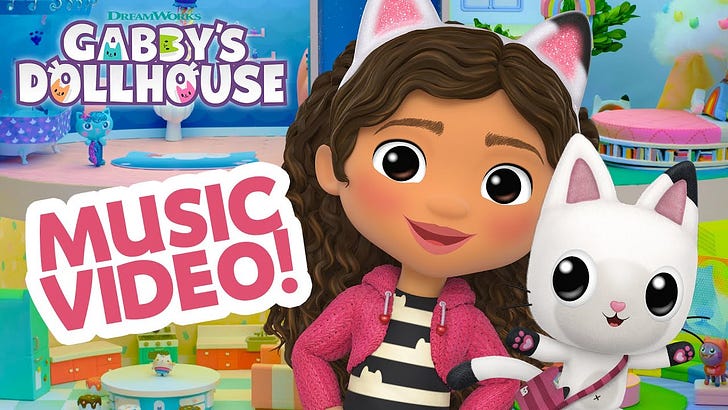
I’ve covered DreamWorks’ playbook for building Gabby’s Dollhouse in not one but two editions of this newsletter. Ten individual lessons:
Going hard on YouTube from the outset
Connecting with kids as a priority (rather than parents)
Expertly managing content roll out
Perfectly landing US product launch
Organic inclusion of awesome toyetic hooks
Doubling down on global linear distribution beyond Netflix
Holding back global product launch
Theming up for later seasons to drive consumer product refresh
Planning the plan, trusting the plan, DOING THE PLAN
And all the other things happening in the background: PR, partnerships, music, retail and beyond
The thing about Gabby’s Dollhouse is that it’s not Bluey. Bluey is lightning in a bottle. But it can be difficult to learn anything productive from lightning in a bottle. That’s why I need to say to clients, “Aspiring to be the next Bluey is pointless” at least once a week. Gabby’s Dollhouse is a fantastic show, expertly developed by seasoned execs, successfully deployed with intention into the kids media landscape. Its goal at outset was to become a franchise. Don’t get me wrong, there is lightning at play, of course. That special unique spark every top show needs. But what’s also at play is the grind of franchise building. And there is plenty to learn by studying that.
The last time I wrote extensively about Gabby’s Dollhouse was nearly two years ago. At that stage, Gabby was certified from my perspective. Launch of the franchise was in the bag. The far less glamorous era of sustain dawned. Ugh, sustain, it couldn’t be less sexy. It also couldn’t be more important. I’ve spoken before about how this era played out for CoComelon and Bluey. In the meantime, Gabby’s Dollhouse has been plowing along planning the plan, trusting the plan, doing the plan. So what has Gabby’s sustain era entailed?
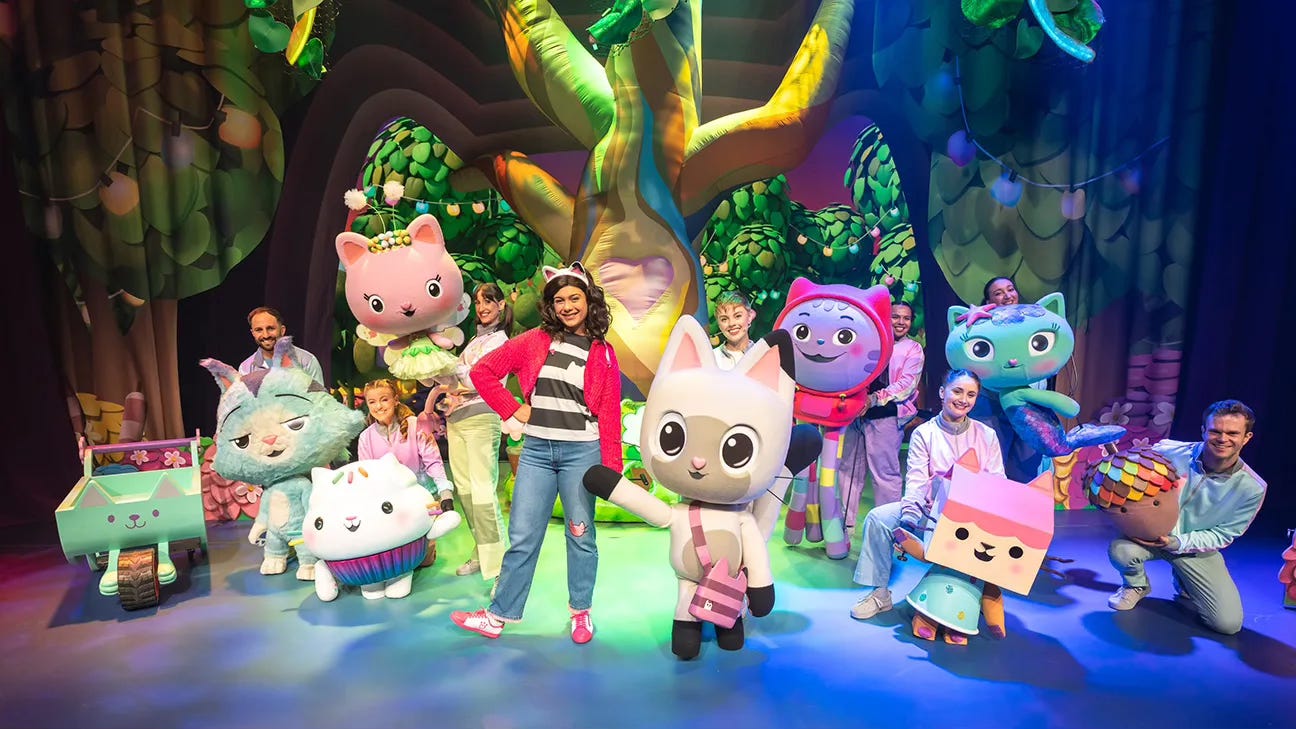
More long-form content on Netflix as a first stop. Naturally. We are now eleven seasons deep, with another confirmed to hit this winter and more in the pipeline. The YouTube playbook remains very much engaged too. Your standard clips, comps, sing-alongs, toy play, full episodes together with bespoke digital formats (includingCraft Room,Bakey with CakeyandGabby’s Schoolhouse). There’s also a Roblox game, launched last September. And Gabby has been getting to know kids off-screen too. That’s something that Ryan Bradley, SVP Marketing at DreamWorks Animation, told us when he spoke to us on the podcast. Kids know something is important when they see it in the real world. And Gabby’s been busy with road shows, character experiences in parks, and museum partnerships. There’s also a live show hitting the US this fall.
And that’s all in addition to the biggest announcement. Gabby’s big shot. Gabby’s Dollhouse: The Moviecoming to a cinema near you this September. This makes Gabby the confident first follower in the paw prints of PAW Patrol. That franchise is now two movies deep with a third to come next year. These have driven major tentpole moments and validated the belief that there really is a market for preschool cinema. Not to be outdone, Bluey and CoComelon are following suit. Preschool cinema is suddenly hot.
The trailer serves. It’s giving Barbie, Cruella, Minions, Smurfs. And if anyone knows how to drive a hit family film at cinemas it’s Universal. But what do the numbers say? Can we gaze at the tea leaves of data and see anything that might inform a casual flutter on the performance of this film? In answer, yes, a few things.
The data tells us that Gabby’s Dollhouse had a bit of a dicky moment in late 2023/early 2024. This was precisely when Bluey Mania was kicking off, with that show’s Season 3 finale. We can see a slight falter in US Nielsen:
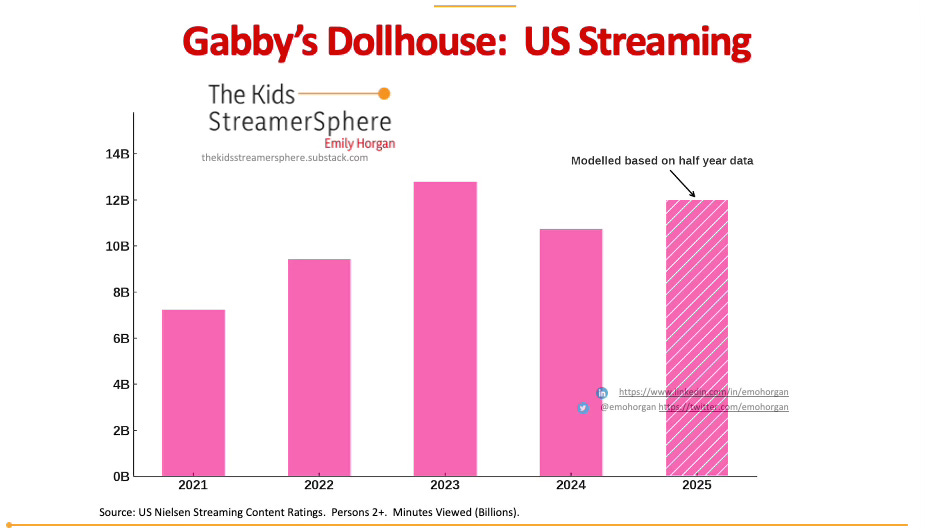
Nothing to scare the horses. A variation this modest in the sustain phase of a franchise is practically steady on target, but we are getting a sense of a ceiling emerging. Gabby’s Dollhouse: The Movie would have been in development by then. In April 2024, DreamWorks shot the shot, announcing the movie and taking yet another shrewd step forward for the franchise. In brand wars, if you’re not trying to take up more space, space will be taken from you, and with the movie Gabby’s Dollhouse had a chance at stimulating the next level of its already healthy audience base.
The start of 2025 was more than back on track for the show. When we look globally, Gabby’s Dollhouse achieves its highest engagement ever from a Netflix perspective and with a very delightful upside.
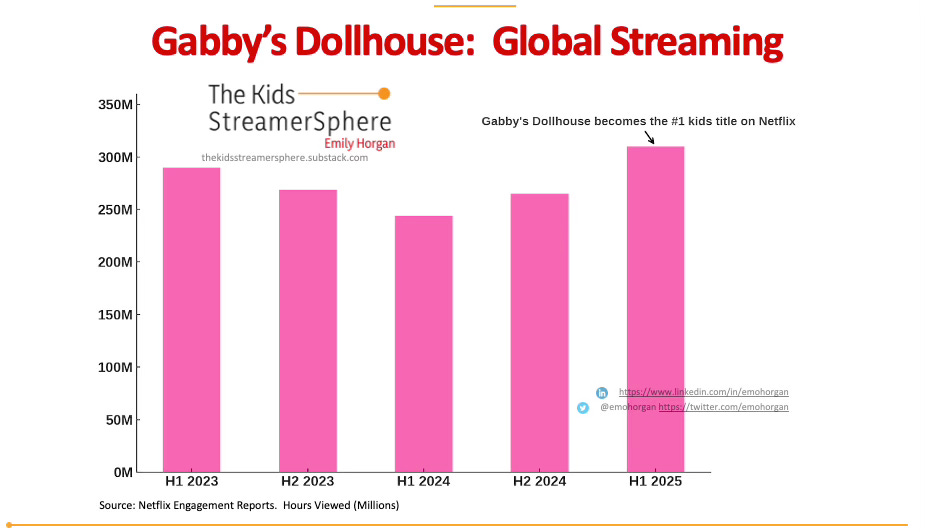
Netflix kids king, CoComelon, was in decline (I could fill a whole other newsletter with speculation on the reasons). That left ground for Gabby to gain, and a crown for Gabby to claim. Per the H1 2025 Engagement Report, Gabby’s Dollhouse is firmly the #1 kids show overall on Netflix globally. What a way to kick off a theatrical launch campaign.
There are other signals in the Gabby mediaverse suggesting a nice tail wind propelling the movie. The Gabby’s Dollhouse YouTube channel, a wind that has been in the franchise’s sails since its origins, is also seeing a definitive uptick in engagement.
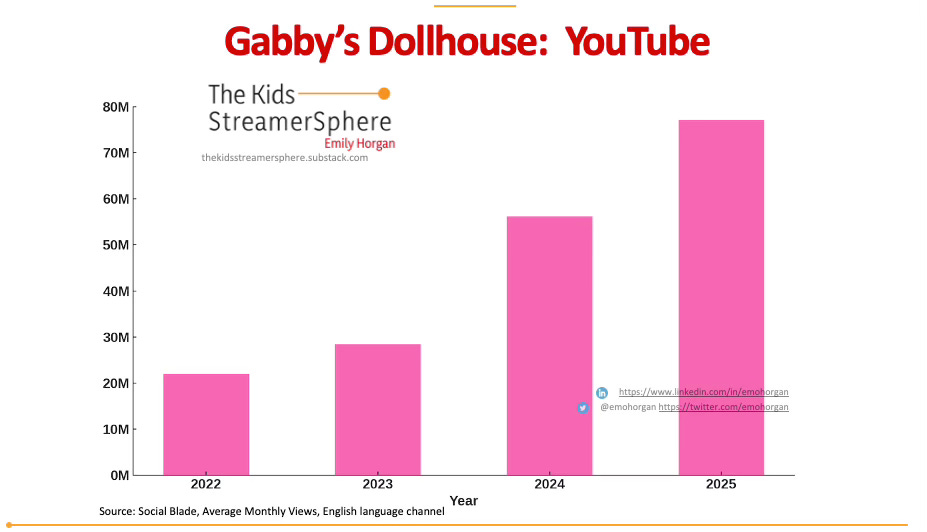
You shoot your shot, Gabby. Let’s see what the OG streaming-originated kids franchise can do in theaters. Competitors will be watching intently. Marketing tactics might be easy to reproduce but it’s hard to replicate four years of grit, grind and good decisions. There’s plenty more to track in the long tail of this strategy too. Data from the Netflix Kids Content Performance Report is giving us some very interesting insights on the impact of streaming windows post theatrical release. If you’d like to hear more about this, please drop me a line.

The life of a movie post theatrical is a trench of the franchise build that will be extremely important going forward, in my opinion. Especially for a franchise grinding the long game, like Gabby’s Dollhouse.